
Tim Stone - 2026 Eisteddfod Overview
Risca Male Choir (RMC) returned to the Eisteddfod stage in August 2026 after their success in 2024. The Eisteddfod was held in Llantwd near Cardigan, West Wales, on one of the biggest sites the Eisteddfod has used. Competing with a brand new program of repertoire—a translation of Non Nobis Domine by Rosephanye Powell, Ukrainian Alleluia by Craig Courtney, and Gwahoddiad in an arrangement by Jeffrey Howard BEM—this was one of Music Director Matthew Harrison’s last performances with RMC.
Although the competition didn’t reap the rewards of 2024, RMC are very proud of their performance. For so many of the choir, this was their first experience of the Eisteddfod stage, and they can hold their heads high. RMC would like to congratulate Bechgyn Bro Taf on their victory and express their congratulations to all competitors in the Tenor/Bass Category. It was a very high-standard competition.
After two months of reflection, discussion, and new direction, below we have the experiences of chorister Kieran Sharratt (2nd Tenor) and audience member Olga Tutton, wife of Chorister Dave Tutton (2nd Tenor).
Kieran Sharratt-2026 Eisteddfod: My First Eisteddfod
My First Eisteddfod: An Englishman Discovers Wales through Song
Well, what an experience. My first Eisteddfod as an Englishman, and if I'm being completely honest, I really didn't know what to expect.
I'd been part of the choir for around 16 or 17 months by this point, having joined the prostate cancer project choir, Men United in Song, after my wife encouraged me to give it a go. There was a reason behind it. My dad had passed away on 23rd December 2024 after a battle with prostate cancer, and my wife thought joining the choir might give me something to focus on. Something positive. It turned out to be one of the best things I've ever done.
Music has always been there; music has always been a big part of my life. Not because I played an instrument or sang in bands—we weren't that sort of family. It was simply always there. Music playing around the house. Music in the car. Music wherever we were. Dad would sing every now and then, and those little memories have stayed with me.
So joining the choir seemed like a natural thing to do, even though standing up and singing in front of people wasn't something I'd ever really imagined myself doing. Over those 16 or 17 months, I'd gone from a complete newcomer to performing at Christmas concerts, annual concerts, local events, and Remembrance services. And somewhere along the way, I'd caught the bug.
Then came the Eisteddfod. An Englishman goes to the Eisteddfod; I'd never been to anything like it in England. To be honest, we don't really have anything comparable.
I'd done my research. I'd looked at where the Eisteddfod was being held, how far the coach journey was going to be—particularly important because I'm not a good coach traveller—and I'd even looked at maps of the Maes so I had some idea of what I was walking into.
Our choir, Risca Male Choir, was going to perform three songs:
Non Nobis Domine, in the Welsh translation Nid I Ni
Ukrainian Alleluia, which had always been a bit of a struggle for me
Gwahoddiad, a traditional Welsh song
On the coach, everyone seemed to zone in. Headphones went in, lyrics came out, parts were practised. People were making sure every word, every note, and every harmony was right. There was a bit of banter between the boys, of course, but underneath it all, there was a real sense of focus.
Then, as we got closer to the Eisteddfod, something struck me. The sheer scale of the celebration. Local residents, farmers, people along the route—you could see just how much the Eisteddfod meant to the community. This wasn't just a festival; this was something deeply connected to Welsh identity.
The changing room… otherwise known as the coach
When we arrived, there was another small problem. There wasn't exactly a changing room waiting for us. So it became: “Right then, boys. Change on the coach.”
Out came the tartan colours of Risca Male Choir—waistcoat, tie, shirt, trousers, the lot—and obviously, the finishing touches: polished shoes, black pants, and black socks.
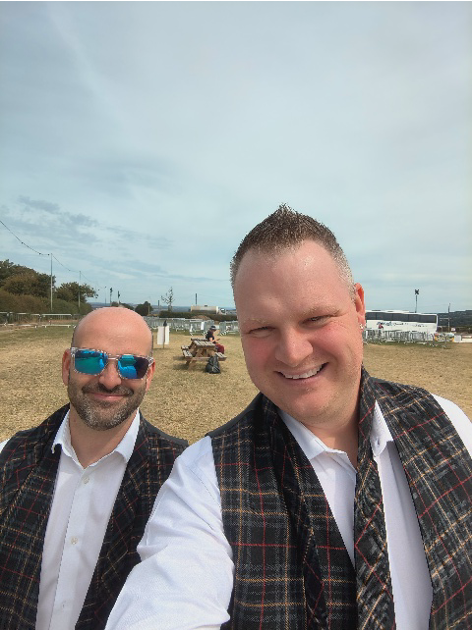
We all got off the coach and started walking down towards the venue. Well… most of them did. Gareth and I were the slow newbies. The rest of the boys had already disappeared into the distance, taking a gentle stroll down the driveway. By this point, Gareth and I were a distance behind, but it didn’t stop us from having a couple of selfies, much to Gareth's annoyance.
Then, halfway down, a golf cart came along, saw that we had lost the rest of the choir, and picked us up. Straight to the door, much to the amusement of the boys, who had all sped off trying to get there first, only to end up arriving after us.
Welcome to the Maes
Stepping into the Maes was something else. The rest of the choir had already been there for a couple of days, some even a week, making a holiday out of it. So we met up with them, and then I started looking around. And everywhere I looked, it was Welsh. Welsh signs, Welsh conversations, Welsh traditions, Welsh stalls, Welsh everywhere.
I was genuinely taken aback. I'd been living in Wales for around 15 years, but this was different. I'd never experienced Wales quite like this. Hearing conversations taking place entirely in Welsh, seeing people celebrating their culture so openly and proudly, and walking around the traditional stalls was genuinely heartwarming. It made me realise just how much Wales means to the people of Wales. And that was something I hadn't fully appreciated before.
My biggest challenge — the Welsh language
Being English, one of the biggest challenges for me has always been the Welsh language. English is my native language. At school I'd done a bit of French and German, but Welsh wasn't something I'd ever learned properly. I'd lived in Wales for 15 years, so I knew a few basics. “Bore da.” That sort of thing. And, of course, I'd learned a few words from road signs. My favourite being “araf”—slow. Not exactly the most useful vocabulary for singing Welsh songs in a male choir!
The truth is, I'd always felt uncomfortable and unconfident when it came to singing in Welsh. I'd sometimes worry that I was letting the rest of the choir down. I remember openly admitting to Matt, our MD, and the rest of the choir that when we were singing Welsh songs and I wasn't 100% confident with the words, I'd sometimes go a little quieter. Then, when a phrase came along that I knew and felt confident with, I'd sing a little louder again and blend back into the section.
It wasn't because I didn't want to learn Welsh. I'd simply never really felt the need or requirement to learn it before, but being at the Eisteddfod started to change that. Listening to Welsh speakers around me, hearing the tone and rhythm of the language, hearing it being spoken naturally everywhere—it made me think maybe I should actually learn a bit more Welsh.
Rehearsal
Before our performance, we spent some time in and around the rehearsal tents listening to the other choirs. And they were good, very good, but I backed us and all the preparation that we had been doing. You could hear the Welsh songs coming through loud and proud, and there was a real sense that we were in serious competition.
Then it was our turn to rehearse, and something changed for me. I'd been nervous; we'd been waiting around for what felt like ages, and the longer we waited, the more the nerves started to build. But as soon as that first note was sung in rehearsal, something clicked. I thought: “Hang on. Yeah. We belong here.” We knew what we were doing. We knew what Matt had told us. We knew our parts. Suddenly, I felt comfortable. Confident. Ready.
There was another interesting dynamic within the choir too. In 2024, Risca Male Choir had won the Eisteddfod. For many of the choristers, that came with a reputation and, perhaps, a little bit of pressure. There was an accolade to defend. For the handful of us who had joined through the Men United in Song project, we didn't have that history. We didn't have that pressure. We were there to do our best and, hopefully, do the boys proud.
Backstage
The waiting continued. And, strangely, that's when the nerves really started to kick in, but it also became a time for reflection. I started thinking about why I was there. Why I'd joined the choir. What had brought me to this point. How much I'd come to enjoy singing. How much passion I'd developed for it. And how much I genuinely loved being part of this group of men.
Then I started thinking about what the Eisteddfod meant to Welsh people. I was standing there as an Englishman, surrounded by Welsh culture, Welsh language, and Welsh tradition, and I suddenly appreciated how privileged I was to be part of it.
Then came the backstage preparations:
Where are you standing?
Who are you behind?
Who are you in front of?
Keep your distance.
Keep your pace.
Make sure the person behind you is on cue.
Don't mess up.
And then you hear the previous choir still singing. You hear the presenter from S4C speaking fluent Welsh. And suddenly… it's your turn. You get the nod. You're going on. Three songs. A lifetime of nerves.
Walking onto the stage, I was almost like a robot. Don't trip. Don't fall. Don't mess up. Because if you fall over on that stage, you're probably going to become a national laughing stock! Thankfully, I made it. Back row, third in from the left…. Ready.
I fixated on Matt. I couldn't tell you how many people were in the audience. I couldn't pick anybody out. For all I knew, there could have been nobody there. My entire world was Matt and waiting for that cue.
Then came the first note. The first words of “Nid i Ni.” And just like that… the nerves disappeared. I felt comfortable. I felt confident. “Yeah. I've got this.”
Three songs. One after another. And then it was over. Just like that. Gone in a blink. We walked off stage, a couple of the Welsh-speaking choristers did the S4C interview, and suddenly we were outside again.
The longest wait
Now came the next part. Waiting for the results. That's when the nerves returned.
Did we do enough?
Did we get everything right?
Did we sound good?
Did anyone mess up?
Did we miss anything?
You start replaying the performance in your head over and over. And while you're doing that, you realise just how much it meant to your family too. My wife and children had seen me on television; seeing their daddy and husband on TV was a brilliant feeling. I was proud, they were proud, and I’m sure my dad would have been proud of me and the choir. That meant an awful lot.
Welsh first
After the performance, we had our big group photograph in front of the Eisteddfod logo, and then we went off to have a look around, grab a couple of drinks, and take everything in. And that's when I noticed something else. Even the people serving at the bars and food halls were speaking Welsh. Everything started in Welsh. Everything was written in Welsh.
And, I'll admit, part of my naive English brain was thinking: “They'll speak English first, surely.” Nope. Welsh first. Every time. But the brilliant thing was that as soon as I explained what I wanted, they switched to English without hesitation and made me feel completely comfortable. And rather than making me feel awkward, it actually made me think: I should learn more. Not because I have to, but because I'd now experienced what it meant to people.
The results
About an hour later, we went back into the pavilion for the results. Again, everything was being broadcast on S4C. Again, everything was in Welsh. The presenter was speaking Welsh. The judges' comments were in Welsh. And I was sitting there thinking: “Right… I've got absolutely no idea what's being said.”
So I watched. I watched the presenter. I watched the other choristers. I watched the crowd. I watched people's reactions. And I waited for one word I knew…. Risca. If I heard Risca, I'd know something was happening.
Unfortunately, it wasn't our day. We didn't make the top three, and, if I'm honest, that hurt. After all the hard work we'd put in, we genuinely felt we'd got a chance of placing. Maybe not necessarily winning it, but certainly competing for a place. So we walked back to the coach feeling a little deflated, a little disappointed, a little downhearted. But that's where the story could have ended… It didn't.
The journey home
Once we were back on the coach, a couple of cans were opened, the singing started, the laughter returned, the banter came back. We sang together and had a laugh, trying to lift the mood after the disappointment. That's what I love about this group. Yes, we wanted to win. Yes, we were disappointed. But ultimately, we'd experienced something together, and that was all that mattered.
What I took away
So, was it the result we wanted? No. Was it disappointing? Absolutely. But would I change the experience? Not a chance.
I arrived at the Eisteddfod as an Englishman who didn't really know what to expect. I left with a much greater appreciation of Welsh culture, Welsh traditions, and, perhaps most importantly, the Welsh language. I've lived in Wales for 15 years, but in one day at the Eisteddfod, I think I learned more about what being Welsh means to some people than I ever had before.
And perhaps the biggest compliment I can give it is this: I went there not knowing what to expect, and I came away wanting to learn more. More Welsh. More about the culture. More about the traditions. And hopefully, one day, I'll be back. Maybe next time I'll even know more than “bore da” and “araf.” And if I'm lucky, maybe I'll even understand what the presenter is saying when the results come around.
But one thing I do know now… I'm very proud to have stood on that Eisteddfod stage with Risca Male Choir, and I'm incredibly grateful that my wife encouraged me to join that choir in the first place.
Olga Tutton -2026 Eisteddfod: A Supporter’s Perspective
National Eisteddfod 2026 - Llantood (Llantwd), North Pembrokeshire, 8 August – A Supporter’s Perspective
It was a beautiful August day as Sue and Mike Sullivan, Maggie and Kevin Lovett, and Dave and I made our way from our B&B (Erw-Lon Farm), waved goodbye by our lovely host Lilwen. She had been a former National Eisteddfod winner herself in the duet category with her sister. She had delighted in reminiscing with us about her experiences and did not need much encouragement to break into song. We were all full of high hopes for the day ahead.
Risca Male Choir (RMC) were participating in the prestigious Tenor/Bass Choral competition on Saturday 8 August—one of 11 choirs in this category. RMC were National Eisteddfod Champions in 2024, led by Matt Harrison, who had also won the Ivor E. Sims Memorial Medal for director of the winning choir.
The Eisteddfod in Pembrokeshire would be the final one Matt would be conducting for RMC after nearly four years leading this fine body of choristers. Matt had also conducted the ladies’ choir “Hear Her Voice” earlier that week. It had been the first time that choir (formed as part of a charity project) had competed in the National Eisteddfod since its inception a year ago. Sherryl Pascoe, our grandson’s maternal mam-gu, was an original member, and she had loved every moment and had wanted to do it all again!
It was another sweltering hot day, and everyone was melting in the heat. Choir supporters and families milled around waiting for access to the Pavilion. The organisers had underestimated the volume of interest in the event, which resulted in the audience only being permitted to watch three choirs at a time before moving out to allow further supporters to enter. RMC were performing tenth out of eleven choirs in the competition. Disappointingly, we were not allowed access and were scattered to fill one or two vacant seats until the auditorium emptied before RMC took the stage, where we gathered a little closer together in two rows near the adjudicators’ table. This meant we only saw the last six choirs perform, and therefore, it was very difficult for us to gauge how RMC had performed compared to the earlier competitors.
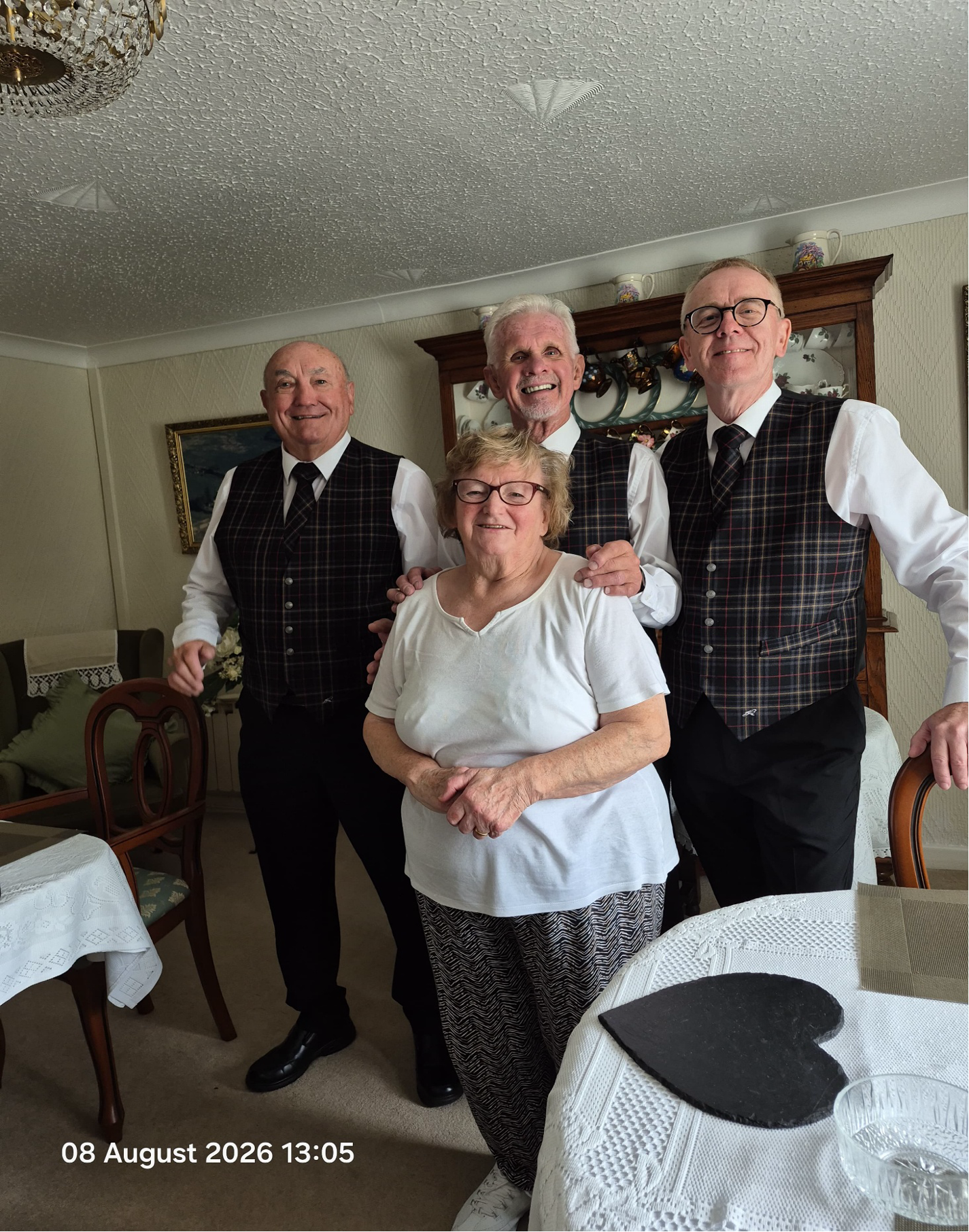
RMC conducted themselves superbly during the competition and looked very smart in their unique tartan waistcoats and ties. This was the first Eisteddfod for some members of the choir who had been recruited following the two charity events fundraising for the Motor Neurone Disease Association (MNDA) and support for Prostate Cymru. Nerves started to show leading up to the competition, but the MD settled them all down during the rehearsal in one of the practice tents.
Accompanied by Jeff Howard, the gents of RMC performed their pieces perfectly and were met with enthusiastic applause from the audience.
The three pieces RMC performed were:
Nid I Ni, O Arglwydd
Ukrainian Alleluia
Gwahoddiad
Sue Sullivan and I sat just behind and to the side of the three adjudicators and were encouraged by their notetaking during RMC’s performance. One of the male judges nodded approvingly at the end of the choir’s competition pieces. This raised our hopes that RMC had done enough to secure a place in the top three. The lady sitting next to me had attended every day of the Eisteddfod and was full of praise for our choir’s performance, particularly in terms of articulation and delivery.
We all waited anxiously for the results to be announced. Everyone needed a drink and a snack, and a few of us wandered around the stalls and exhibitions around the site. There were plenty of examples of food and drink showcasing local products.
When the results were announced in the Pavilion, there was stunned silence from the choristers and supporters alike. We all had high hopes, but on this occasion, our triumph of two years ago was not to be repeated.
Competition Results: Tenor | Bass Choir
1st Place - Bechgyn Bro Tâf
2nd Place (Runner-up) - Côr Meibion Taf
3rd Place(Runner-up) - Côr Meibion Ar ôl Tri
The feedback from the adjudicators had been minimal (not a good sign). Obviously, they had not been as impressed with RMC’s performance as the audience appeared to be.
Returning to our B&B, we all agreed how much we had enjoyed RMC’s performance and were already looking forward to the gents’ next competition—whenever and wherever that may be.
